
Introduction
Advertising plays an important role in helping businesses attract customers and build a strong online presence. Previously, companies mainly promoted their products and services through traditional channels such as newspapers, television, radio, and printed posters. With the growth of digital platforms, businesses have gained new ways to connect with their audiences. One major development influencing this change is artificial intelligence (AI), which is transforming how modern advertising works.
An artificial intelligence advertising campaign uses AI-powered technology to understand customer preferences, develop targeted advertisements, evaluate campaign results, and support marketing decisions. These tools can help businesses reduce repetitive work, save time, and connect with people who are more likely to be interested in their products or services. Companies of different sizes are now exploring AI to improve their advertising strategies and strengthen their digital marketing efforts.
In this blog, we will explore how AI is used in advertising, its practical applications, major benefits, potential challenges, and future possibilities for the digital marketing industry.
What Is Artificial Intelligence in Advertising?
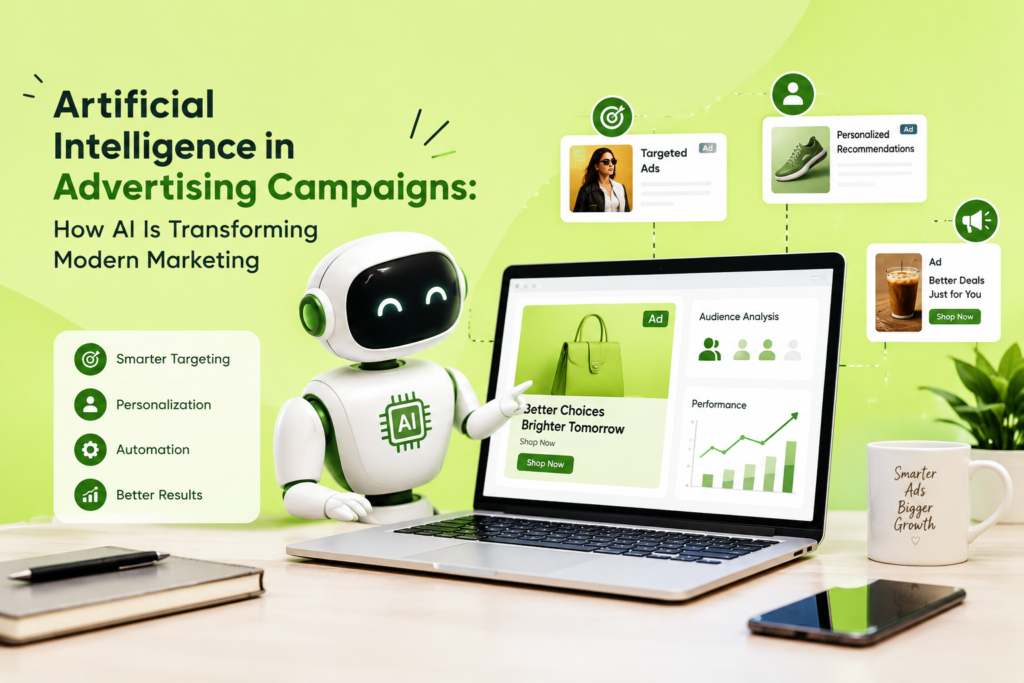
Artificial intelligence in advertising involves using intelligent computer systems to plan, create, deliver, and improve advertisements. An artificial intelligence advertising campaign uses AI-powered tools to process large amounts of information, identify useful patterns, and provide insights that help marketers make informed decisions.
These tools can analyze customer interests, browsing behaviour, search activity, and interactions with digital content, where permitted. Businesses can use these insights to develop advertisements that are more relevant to their target audiences.
For example, an online clothing store might use AI tools to identify customers who frequently explore casual wear. The business can then display advertisements featuring similar styles and products. This approach allows companies to create more personalized promotions that may increase audience engagement and improve campaign performance.
AI supports marketing professionals by handling repetitive activities and analyzing information efficiently. Rather than replacing human expertise, it can assist with creative development, strategic planning, and decision-making.
1. Personalized Advertising Experiences
Personalization is one of the key applications of an artificial intelligence advertising campaign. People are often more interested in advertisements that reflect their needs, preferences, and shopping interests.
AI tools can analyze how customers interact with a brand to identify the products, services, and content that appeal to different audience groups. Marketers can use these insights to develop relevant advertisements for specific customer segments.
For example, a beauty brand might show skincare promotions to people interested in skincare products while presenting makeup collections to another audience. This approach makes advertisements more relevant instead of displaying the same promotions to everyone.
Personalized advertising can encourage customer engagement and help businesses communicate the benefits of their products more effectively. However, marketers must respect customer privacy, protect personal information, and use data responsibly and ethically.
2. Better Audience Targeting
A successful artificial intelligence advertising campaign focuses on reaching people who are genuinely interested in the products or services being promoted. Even a well-designed advertisement may not achieve the desired results if it reaches the wrong audience.
AI helps advertisers identify potential customers by analyzing demographic details, interests, online activities, and previous campaign interactions where permitted. These insights help marketers understand which audience groups are more likely to engage with their advertisements.
Platforms such as Google Ads and Meta Ads provide AI-powered features that assist with audience targeting, bidding, and campaign optimization.
For example, a local fitness centre can use digital advertising tools to reach people in its service area who may be interested in fitness memberships. Reaching a relevant audience can help businesses use their advertising budgets more effectively. However, marketers should regularly review campaign results to ensure their targeting aligns with business goals.
3. AI-Powered Content Creation
Developing advertising content takes time, creativity, and careful planning. Marketers often need to prepare headlines, captions, product descriptions, images, and different advertisement versions for various digital platforms.
AI tools can simplify parts of this process by suggesting content ideas, creating headline drafts, writing promotional messages, and organizing creative concepts. Image-generation and editing tools can also help marketers explore visual ideas for their advertisements.
For example, a small bakery preparing a festive promotion could use AI to brainstorm catchy slogans, draft social media captions, and explore ideas for promotional graphics.
Before publishing AI-generated material, marketers should review it carefully for factual accuracy, grammar, originality, brand voice, and audience suitability. Human creativity remains essential for producing authentic advertising messages that build emotional connections with customers.
4. Automated Advertising Campaigns
Managing an artificial intelligence advertising campaign may involve setting budgets, tracking results, testing advertisements, and deciding how advertising funds should be allocated.
AI-powered advertising platforms can automate certain marketing activities and adjust campaign settings based on performance data. Depending on the platform and selected settings, these features may help manage bids, deliver advertisements, and optimize campaigns towards specific objectives.
For example, an online store promoting several products might use automated bidding to support its chosen advertising goal. The system can use available performance signals to adjust bids according to its optimization strategy.
Automation can reduce repetitive work and give marketers more time for strategic planning, creative development, and business growth. However, automated campaigns still require proper setup and regular supervision. Marketers should define clear objectives, set suitable budgets, and monitor results instead of assuming every automated decision will produce positive outcomes.
5. Predicting Customer Behaviour
Artificial intelligence can help marketers identify patterns in past data and forecast possible customer behaviour. This process is commonly known as predictive analytics.
An artificial intelligence advertising campaign can use these insights to estimate which products may attract attention, which customers might respond to special offers, and which advertisements could perform better.
For example, an online store can review previous sales records and advertising results to identify products that become popular during seasonal shopping periods. Marketers can use this information to plan promotions in advance and prepare more relevant advertising messages.
However, predictions cannot guarantee future results. Changes in customer preferences, market trends, competitor activities, and unexpected events can affect campaign performance. Therefore, marketers should treat AI-generated forecasts as helpful guidance and combine them with human judgment and regular performance analysis.
6. Improving Advertising Performance with Data Analysis
Analyzing results is essential for understanding whether an artificial intelligence advertising campaign is meeting its marketing objectives. Common performance metrics include impressions, clicks, click-through rate, conversions, cost per click, and return on advertising spend.
AI-powered tools can analyze large amounts of advertising data and uncover trends that marketers might not easily notice on their own. This helps businesses compare the performance of different ads, audience segments, and campaign periods to understand what works best.
For example, an artificial intelligence advertising campaign may receive a high number of clicks but produce only a few sales. This could suggest that the advertisement, landing page, or product offer needs to be improved.
By reviewing these insights, marketers can experiment with different headlines, images, special offers, and landing page layouts. Regular analysis allows businesses to make informed changes, use their advertising budgets more wisely, and discover ways to improve overall campaign performance.
7. Chatbots and Conversational Advertising
AI-powered chatbots can support an artificial intelligence advertising campaign by helping businesses communicate with potential customers through websites, messaging apps, and other digital channels. They can answer common questions, explain product features, and guide users towards relevant information.
For example, a travel agency could use a chatbot to respond to enquiries about holiday packages, travel dates, prices, and booking procedures. Customers interested in a particular offer can receive quick assistance without always having to wait for a customer service representative.
Chatbots can strengthen an artificial intelligence advertising campaign by making information easier for potential customers to access. They can handle routine enquiries and provide basic assistance outside regular business hours, depending on their configuration.
However, complicated questions and sensitive customer issues may need personal attention from a human representative. Businesses should explain when customers are interacting with an automated system where appropriate and make it easy to reach a real person when further assistance is needed.
8. Benefits of an Artificial Intelligence Advertising Campaign
An artificial intelligence advertising campaign can provide several benefits for businesses by improving efficiency, helping marketers understand their audiences, and supporting better advertising decisions.
-
- Increased efficiency: AI can take care of repetitive tasks, allowing marketers to focus more on creative ideas and campaign planning.
- Improved personalization: Businesses can tailor advertisements to suit the interests and preferences of different audience groups.
- Data-driven decisions: AI tools can evaluate campaign results and customer interactions, helping marketers make better-informed decisions.
- Better budget management: Automated bidding and campaign management features can help businesses allocate advertising funds more effectively.
- Faster content creation: AI can help generate promotional ideas, draft advertising messages, and explore creative concepts.
- Continuous improvement: Some advertising platforms can refine campaign delivery by analyzing performance data and audience responses.
The results of an artificial intelligence advertising campaign depend on accurate data, clear objectives, suitable tools, and regular human supervision. Although AI can improve advertising processes, it cannot guarantee success in every situation.
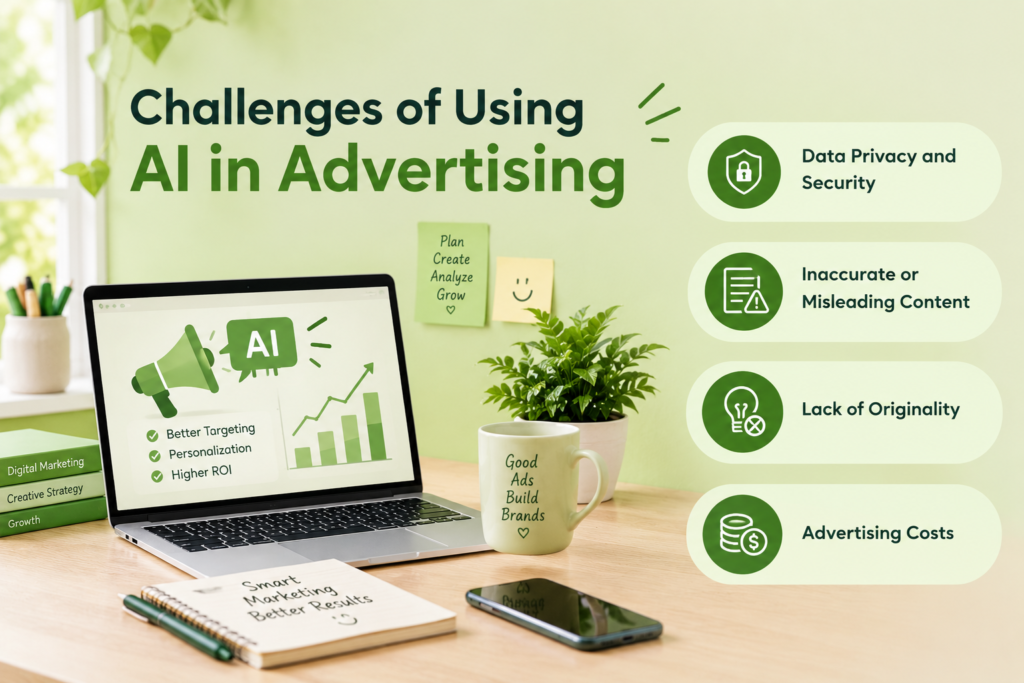
9. Challenges of Using Artificial Intelligence in Advertising
Despite its advantages, using AI in advertising also presents challenges that businesses should understand before adopting these technologies.
Data Privacy and Security
AI tools may process customer information to support personalized advertising and audience targeting. Businesses should follow applicable privacy regulations, obtain consent when required, and safeguard sensitive information. Collecting only the data needed for a specific purpose can also help reduce privacy risks.
Inaccurate or Misleading Content
AI-generated advertisements
Advertising Costs
Some AI-powered advertising platforms and advanced marketing tools can be expensive, especially for small businesses with limited budgets. Before investing in an artificial intelligence advertising campaign, businesses should compare different tools, assess their costs, and determine whether the features provide enough value to support their marketing goals.
Overdependence on Automation
Automated advertising systems may not always fully understand a business’s values, changing market trends, or specific customer needs. Therefore, marketers should regularly evaluate campaign performance and apply their own judgment before making important decisions.
By understanding these limitations, businesses can manage an artificial intelligence advertising campaign more responsibly, protect customer trust, and create advertising strategies that align with their marketing goals.
 The Future of AI in Advertising
10. The Future of Artificial Intelligence in Advertising
The future of an artificial intelligence advertising campaign will be shaped by improvements in AI technology and the growing availability of intelligent marketing tools. Businesses may increasingly rely on AI to develop different creative variations, evaluate campaign performance, personalize customer experiences, and coordinate promotional activities across multiple channels.
Generative AI can help marketers explore fresh visual concepts, write promotional messages, and develop new advertising ideas. Predictive analytics may support campaign planning, while AI-powered conversational tools can make interactions between customers and brands more convenient.
As these technologies advance, businesses will need to focus on using AI safely, fairly, and responsibly. Protecting customer information, maintaining content accuracy, being transparent about AI use, and avoiding unfair targeting should remain important priorities.
In the future, effective marketers will be those who combine technological capabilities with human understanding. Creativity, empathy, strategic thinking, and a clear understanding of customer needs will continue to be essential for developing meaningful advertising campaigns that build trust and support business growth.
Conclusion
An artificial intelligence advertising campaign can help businesses understand their target audiences, create personalized advertisements, automate selected marketing tasks, and evaluate campaign performance. These capabilities can make advertising activities more efficient and support better decisions based on campaign data. However, AI should complement human expertise rather than replace it entirely. Businesses must pay attention to data privacy, content accuracy, originality, and ethical practices when using AI-powered tools.
By combining AI technology with creative ideas and regular performance analysis, marketers can develop advertising strategies that meet audience needs and support business goals. As digital marketing continues to change, understanding how to use AI responsibly can be an important advantage for anyone pursuing a career in advertising and marketing.
Ultimately, a successful artificial intelligence advertising campaign relies on more than advanced technology. It also requires relevant messaging, a clear understanding of customer needs, and meaningful relationships with the target audience.
Author : fida fathima